Precision vs Recall: The Essential Difference That Shapes RAG Systems
Understanding precision and recall is critical for building effective RAG systems. Learn how these metrics determine retrieval quality, the precision-recall trade-off, and why a RAG system with poor recall misses critical information while poor precision drowns the LLM in noise.
Precision and recall are two fundamental metrics in machine learning and information retrieval, yet most engineers remember only the formulas. In GenAI and RAG systems, these concepts become critically important—and the formulas become secondary. Understanding when precision matters more than recall (and vice versa) directly impacts whether your RAG system generates accurate answers or confidently hallucinates.
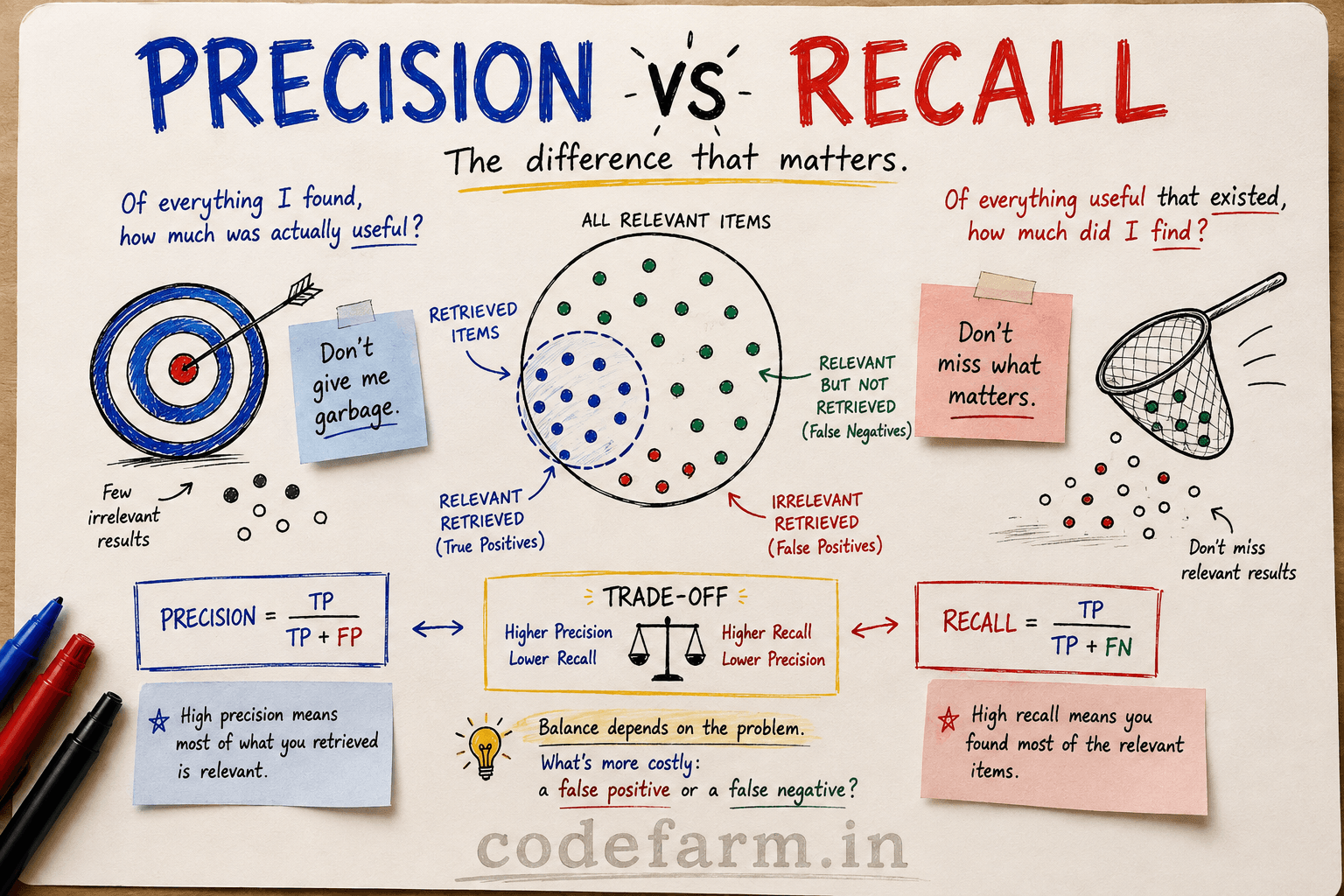
Precision vs Recall: The Simple Difference That Matters in GenAI
There are two terms that appear everywhere in Machine Learning, Search, and now GenAI:
Precision and Recall.
Most of us learn the formulas:
Precision = TP / (TP + FP) Recall = TP / (TP + FN)
The formulas are easy.
The confusion starts when someone asks:
"For a RAG system, should I optimize for precision or recall?"
The answer becomes much easier once you stop thinking about the formulas and ask two simple questions:
Precision: Of everything I found, how much was actually useful?
Recall: Of everything useful that existed, how much did I find?
That's the fundamental difference.
Let's Forget AI for a Moment
Imagine you're searching for Italian restaurants in Delhi.
There are 100 restaurants that actually match your requirement.
Your search engine returns 10 restaurants.
Of those 10, 8 are actually relevant.
Precision
You received 10 results, and 8 were useful.
Precision = 8 / 10 = 80%
So precision tells us:
How good were the results I returned?
Recall
There were 100 relevant restaurants, but you found only 8.
Recall = 8 / 100 = 8%
So recall tells us:
How much of the useful information did I miss?
This gives us an easy mental model:
Precision = Don't give me garbage.
Recall = Don't miss what matters.
Why Do We Need Both?
Imagine a search engine that returns only three results.
They are almost always relevant.
That's high precision.
But there may be hundreds of other relevant results that were never shown.
That's low recall.
Now imagine another search engine that returns 500 results.
You probably captured most of the relevant information.
That's potentially high recall.
But perhaps 400 of those results are irrelevant.
That's low precision.
So there is often a trade-off:
Fewer results
     ↓
Higher precision
Potentially lower recall


More results
     ↓
Higher recall
Potentially lower precision
Neither is universally better.
It depends on the problem.
Where Does F1 Fit?
Sometimes we care about both.
That's where F1 score comes in.
F1 = 2 × (Precision × Recall) / (Precision + Recall)
It provides a single number that balances precision and recall.
For example:
- Precision = 80%
- Recall = 20%
A simple average would be 50%.
But F1 is only about 32%.
That's intentional.
A system shouldn't get a great score by being excellent at one metric while completely failing at the other.
But even F1 isn't always the right objective.
The business problem determines which metric matters more.
When Does Precision Matter?
Precision matters when false positives are expensive.
Spam Detection
If you classify legitimate emails as spam, users may miss important messages.
You care about precision.
Search
If every search produces lots of irrelevant results, users lose trust in the system.
Precision matters.
Recommendations
If a recommendation system constantly suggests irrelevant products or videos, the experience becomes poor.
Again, precision matters.
When Does Recall Matter?
Recall matters when missing something is more expensive than investigating a false positive.
Fraud Detection
You may prefer investigating some suspicious transactions rather than missing real fraud.
Security
Missing a genuine security threat can be much worse than investigating a false alarm.
Medical Screening
A screening system may prioritize finding potentially concerning cases, even if some turn out to be false positives.
The general question is:
Which is more costly: a false positive or a false negative?
That determines where you should put more emphasis.
Now Bring This Into GenAI
This is where precision and recall become particularly interesting.
Consider a typical RAG system.
A user asks:
"What is our company's parental leave policy?"
The system needs to retrieve relevant information from a knowledge base before asking the LLM to generate an answer.
Conceptually:
User Question
      ↓
Retriever
      ↓
Relevant Documents
      ↓
LLM
      ↓
Answer
Suppose your knowledge base has 10,000 chunks.
Only 100 chunks are relevant to the question.
Your retriever returns 20 chunks.
Of those 20, 16 are relevant.
Precision
16 / 20 = 80%
Most of what you gave the LLM was useful.
Good precision.
Recall
16 / 100 = 16%
You found only a small fraction of the relevant information.
Poor recall.
And this is where RAG systems can fail in interesting ways.
Why Low Recall Can Be Dangerous in RAG
Imagine one retrieved document says:
"Employees can work remotely for up to 30 days."
Sounds straightforward.
The LLM may answer:
"Employees cannot work remotely for more than 30 days."
But another document in the knowledge base contains an important exception:
Employees working from countries where the company has a legal entity may qualify for a different policy.
That document wasn't retrieved.
The LLM never saw it.
This is fundamentally a retrieval recall problem.
And this leads to one of the most important ideas in RAG:
An LLM cannot use information that the retrieval system never provided to it.
You can have a powerful model and an excellent prompt.
If retrieval misses the critical information, the final answer can still be wrong.
But High Recall Alone Isn't Enough
Now let's make the opposite mistake.
To avoid missing anything, suppose you retrieve 500 chunks.
Maybe you've captured almost everything relevant.
Great recall.
But perhaps only 30 of those chunks are actually relevant.
Now the LLM receives a huge amount of noise.
That can lead to:
- irrelevant context
- conflicting information
- larger prompts
- higher token costs
- increased latency
- difficulty identifying the important information
So simply saying:
"Let's maximize recall!"
isn't a good RAG strategy either.
You need a balance.
This Is Why RAG Often Uses Retrieval + Reranking
A common approach is:
              Query
                ↓
        ┌──────────────┐
        │  Retriever   │
        └──────┬───────┘
               ↓
        50 candidate chunks
               ↓
        ┌──────────────┐
        │  Reranker    │
        └──────┬───────┘
               ↓
        5–10 best chunks
               ↓
              LLM
The first stage can be recall-oriented.
Retrieve a reasonably broad set so you don't miss important information.
Then the reranker improves precision by identifying the most relevant chunks.
This is a very useful way to think about production RAG architecture:
Retrieve broadly. Rerank aggressively. Generate from the best context.
What About Top-K?
You'll often see a RAG configuration like:
topK = 5
This means the retriever returns the top 5 results.
Changing K affects the precision/recall trade-off.
A smaller K may give you:
- less noise
- better precision
- potentially worse recall
A larger K may give you:
- more relevant information
- better recall
- potentially more irrelevant context
So top-K isn't just a random tuning parameter.
It directly affects retrieval behavior.
One Important Point: Retrieval Quality ≠ Answer Quality
This is particularly important in GenAI.
Suppose retrieval has excellent precision and recall.
The LLM can still generate a bad answer.
Or retrieval can have poor recall and cause the LLM to miss a critical fact.
So think of a RAG system as a pipeline:
Retrieval Quality
       ↓
Context Quality
       ↓
LLM Reasoning
       ↓
Final Answer
Precision and recall help us evaluate retrieval, but they don't tell us everything about the final answer.
The Mental Model to Remember
Don't memorize the formulas first.
Remember these two questions:
Precision
"Of everything I found, how much was actually useful?"
Recall
"Of everything useful that existed, how much did I find?"
Or simply:
Precision = Don't give me garbage.
Recall = Don't miss what matters.
And that's why these concepts are so important in GenAI.
A RAG system with poor precision can overwhelm the LLM with irrelevant context.
A RAG system with poor recall can miss the very information needed to answer the question correctly.
The goal isn't to blindly maximize one metric.
The goal is to build a retrieval pipeline that finds enough of the right information, removes the noise, and gives the LLM the context it actually needs.
That's the real meaning of precision vs recall in modern AI systems.
More from Generative AI
Browse more articles and guides on this topic.